

About this site
HOME PAGETechnology
80 COLUMN CARDS PRIVACY DISCLOSURE BYOD EYE-FI RASPBERRY PI ARDUINO ESP8266 PROGRAMMING MISSILESManufacturing
GRADUAL DECLINE THE FINAL DAY MATHER & PLATT TRAFFORD PARK 25 YEARS AT GEC GEC HISTORY MICROMETER HEAVEN METRICATIONEnergy
THE PROBLEM GULF OF MEXICO CARBON CONSCIENCEMy Web Sites
MY DESIGNSMiscellaneous
BOILER MONITOR THE LIBRARY MY KINDLE ODD STUFFLinks
WHISKY GALORE TOURS TELERAMICS THE B5105 TELEGRAPH POLES WORLD WIDE WORDS NGTE PYESTOCK
THE LIBRARY
Well of course it's not a real library - that was just to get you to click it! I've listed here the books that I'm reading currently, what I'm planning to read next and also some recommendations.
CURRENT READING
|
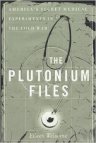
The Plutonium Files by Eileen Welsome
is a well-written account of how American government
agencies injected plutonium into innocent and unsuspecting recipients to see how much of the material humans could tolerate.
The book is currently out of print but new and second-hand copies are still available from various sources.
When the vast wartime factories of the Manhattan Project began producing plutonium in quantities never before seen on earth, scientists working on the top-secret bomb-building program grew apprehensive. Fearful that plutonium might cause a cancer epidemic among workers and desperate to learn more about what it could do to the human body, the Manhattan Project's medical doctors embarked upon an experiment in which eighteen unsuspecting patients in hospital wards throughout the country were secretly injected with the cancer-causing substance. Most of these patients would go to their graves without ever knowing what had been done to them. |
 |
WHAT I'M READING NEXT
| Cream Teas, Traffic Jams and Sunburn: The Great British Holiday by Brian Viner looks like being an excellent read and so my next book will be his Tales of the Country. The book description says "Brian Viner and his family had enjoyed much about their nice little middle-class patch of north London, but gradually realised they were suffering from a severe case of 'metropause' - the desire to swap the hassles of London life for the serenity of the countryside. After a long search they found the house of their dreams in rural Herefordshire. But is the quiet life all it's cracked up to be? More importantly, where does one go to get a decent cappuccino? 'A Year in Provence' with less sunshine but more laughs, "Tales Of The Country" is a wonderfully entertaining and heart-warming account of the Viners' adjustment from town to country. Full of anecdote and character, it is a superbly beguiling book about what is really important in life, and the joys and trials encountered along the road towards it." | 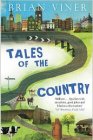 |
RECOMMENDED READING
| Confronting Collapse by Michael Ruppert. The book starts with a rational, logical and believable analysis of the current situation regarding peak oil. It's so believable that I found myself seriously considering cancelling my pension payments, resigning from my job and moving to a quiet rural location where I could live in a sustainable way in readinesss for the peak oil disaster that will unfold. However, about a third of the way through the book Ruppert's arguments lose all credibility with a dramatic change to a paranoid, sarcastic and generally unbalanced attitude. I even wondered whether someone else might have written this section. He manages to recover somewhat for the last third but his credibility remains tainted. The only other comment is that the book is based on US data rather than world. | 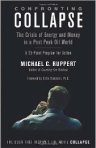 |
| If you like Bill Bryson, then you'll enjoy Cream Teas, Traffic Jams and Sunburn: The Great British Holiday by Brian Viner. The British on holiday: how can four simple words evoke so many vivid images, images of raw sunburn and relentless rain, of John Bull's Pub (in Lanzarote) and Antonio's Tapas Bar (in Torquay), of endless queues to get through security at Manchester Airport, or Gatwick, or Glasgow, or Luton, and endless tailbacks on the M5, or M6, or M25, but also images of carefree sploshing in Portuguese swimming-pools and lazy lunches in the Provencal sun? In this funny, acutely observed and engaging social history, Brian Viner celebrates the holidaying British, with their quirks and their quinine tablets, and their blithe assumption that the elderly man selling oranges at the roadside in Corfu, so photogenic with his walnut face and three teeth, must surely understand just a few, uncomplicated English sentences. He examines the fortnight-long cruise at one end of the holiday spectrum, and a day's rambling in the Lake District at the other. He looks at how the holidaying British evolved into the big-spending, many-headed beast we know today, by recalling not only the holidays that we took as children, but the holidays our grandparents, and their grandparents, took. It is a story that connects Blackpool with Barcelona, Mauritius with Margate. It is a story, indeed, that connects us all. | 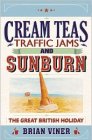 |
| Beyond Oil by Kenneth Deffeyes. A very readable book on the formation, discovery, extraction and sources of coal, oil and gas. Deffeyes also explains Hubbert's peak oil calculations. | 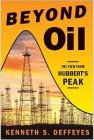 |
| No Place To Hide by Robert O'Harrow. This is a chilling book by award-winning "Washington Post" reporter Robert O'Harrow. He uncovers the frightening new alliance between government and business: data collection. For years private companies have gathered all kinds of information about consumers and sold it for profit. Since the 9/11 terrorist attacks, they have sold it to the government. In return, they have received vastly expanded resources and freedom from legal restraint. Every aspect of our lives is now recorded and tracked. | 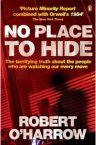 |
| Taking Chances by John Haigh. An essential guide if you want a good introduction to the theory of probability but without any heavy maths. The theory behind many tricks and TV and card games is explained in a simple and very readable style - you can open the book anywhere and find something of interest. | 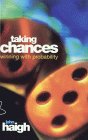 |
| Secret Underground Cities is all about the extraordinary underground factories, storage depots and treasure houses that were constructed at great expense and secrecy during the Second World War and afterwards. Photographs and plans of various sites are included. | 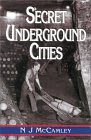 |
| Locomotive Boiler Explosions was one of ten books rated as "I couldn't pick it up" by You magazine in November 1992, but I disagree! It provides an interesting look at how and why locomotive boilers exploded - which they seemed to do with remarkable frequency in the early days. It's only through accidents and the subsequent investigations that the essential lessons were learnt to provide us with today's safer engineering. | 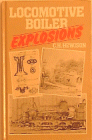 |
| The New Hacker's Dictionary is a reference for all ancient and modern computer terms, phrases and acronyms. The great thing about this book is the unexpected humour and irreverent attitude. |  |
| Wildwood - A Journey Through Trees by Roger Deakin. I'm not usually a reader of books like this but it is a good read if you like trees and nature. Some of Deakin's descriptions make it almost possible to smell the smoke, the tree sap and the damp mist. It also has some humour and describes well his love of nature and living with trees. You might need to keep a dictionary handy for the occasional word! |  |